

A case study in consequence. The Trade Journeywork
A 1–4 player cooperative exploration and boss-battler built on a single rule: the randomness you fight through has to be randomness you built.
I wanted variance players could take credit for
Cooperative boss-battlers resolve combat with dice. A table can play a turn correctly and still lose to variance it had no hand in creating.
The post-mortem becomes a conversation about luck instead of a conversation about decisions.
Removing randomness was never the answer — the tension of a boss fight depends on not knowing. So I moved where it comes from: players compose the distribution during downtime, then live inside it during the fight.
Every other system is downstream of that decision. Combat, recovery, exploration pacing and progression are all edits to randomness the players created.
So I made stamina, nerve and focus the core system
Each player carries a bag of tokens standing in for stamina, focus and nerve. Attacking draws from it. Defending draws from it. Skill checks and hazards draw from it.
Because the bag is finite and the player chose its contents, a bad draw is legible — it traces back to a loadout, a spend, or a refusal to recover. The same moment that reads as bad luck with dice reads as consequence here.
A die has no memory. Draw from a bag and the bag is permanently different: one set of resources, moved through four states with deliberately asymmetric exits.
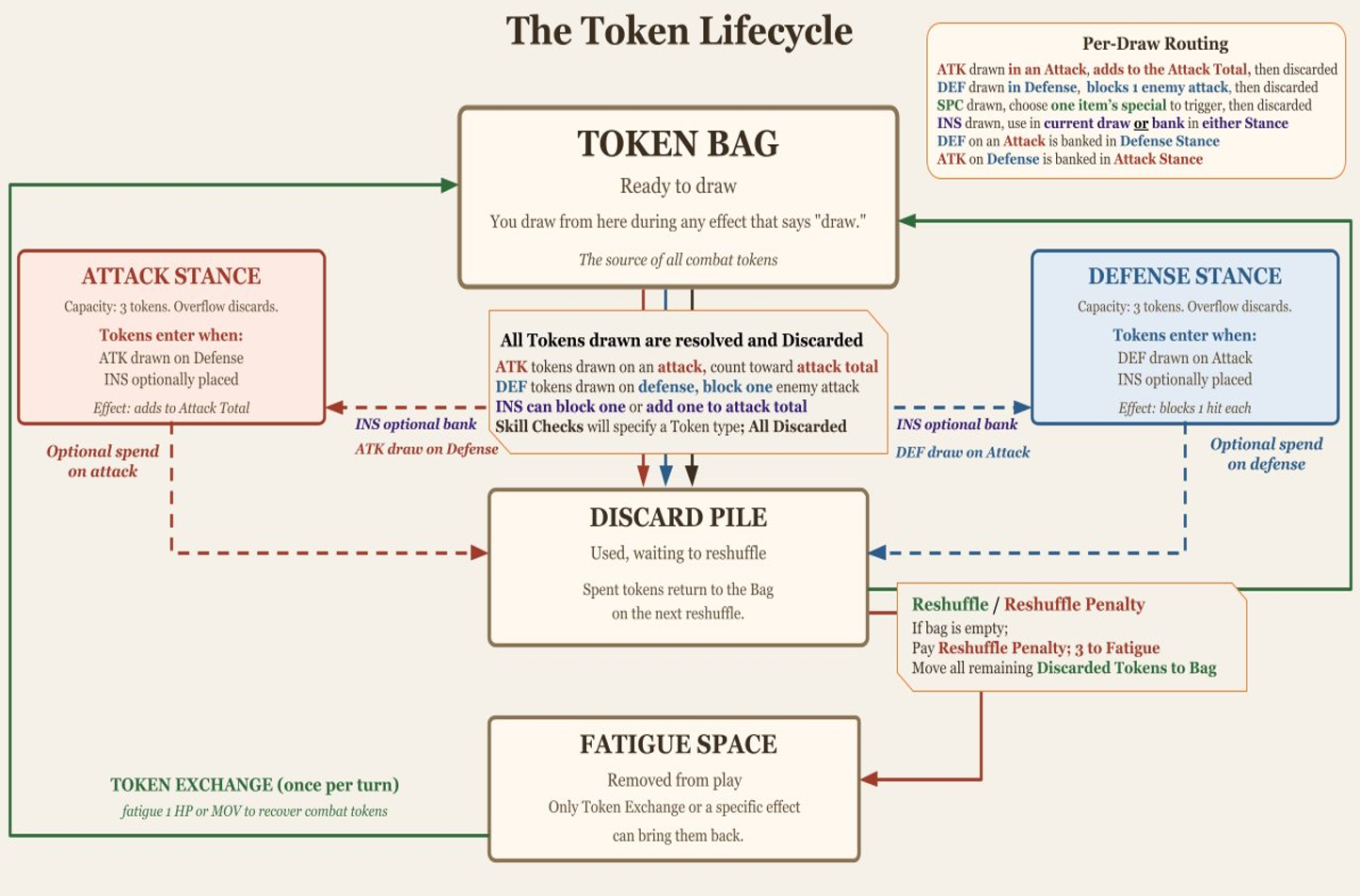
Two bags, two kinds of memory
The Token Bag is a resource you own and can count. The Composure Bag is a record you contribute to and cannot.
Your bag holds Attack, Defense, Instinct and Special. The party shares one Composure Bag of emotional state, where no token is good or bad on its own — only the composition in front of you is read. In the Fight it becomes the enemy's endurance: each point of damage takes one token out, and when it empties the enemy falls.
Its size is never printed. Every choice on the trail is a deposit into a bag you will have to fight through later.
The probability of drawing k of something in n draws from a finite pool — without putting anything back. Dice and percentage rolls assume replacement, so the odds never move. Here they move on every draw.
Put 20 marbles in a jar: 14 red, 6 blue. Reach in and take four without looking. You want at least three reds.
Add a second jar, shared. It holds 12 marbles: 4 green, 4 amber, 4 grey. Each turn you reveal 5 from it, and 3 or more green triggers a penalty. Every red you draw from your own jar also removes one marble from this one.
The bags are the start, not the whole story
Four systems that integrate into narrative you feel.
Supported by a production architecture built for rapid iteration, content development and expansion.
One monster, five cards
There is no story to read. There is a record you leave behind.
The Trade has no narrator and almost no prose. Narrative is carried by four mechanisms that already had to exist for the game to work.
A tile states a situation and prices the options. What the party spends answering it becomes the shared state the next tile reads. Nobody writes down what happened, and the game still knows.
The result is that every story at the table is about a decision someone made, because there is no other source of events in the system.
The Skinner can reappear Journeys later and know exactly what you did — whether you paid, stole, or walked away.
State is naturally tracked through Fieldnotes, Inventory and the two bags
Every card has to teach its own resolution
Players should not be opening the rulebook mid-turn. Learn one card and you can read all of them.
Colour does most of that work. A player tells a Scrap from a Hazard from a Loot Cache across the table, and knows roughly what a tile will cost before it is their turn.
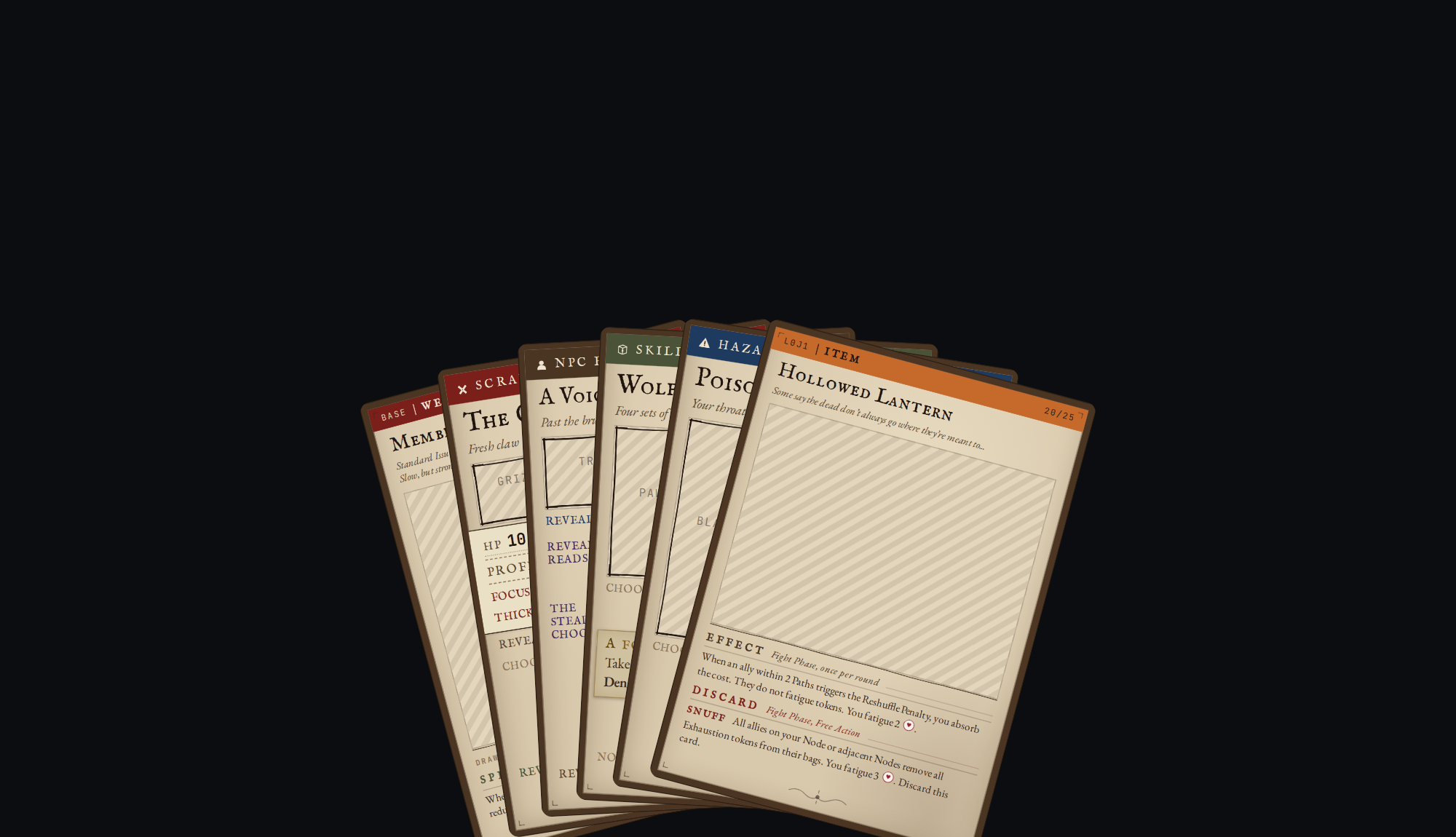

Layout is code, so rewrites are cheap
The bottleneck on a systems-heavy tabletop game is not design. It is re-laying out a hundred components every time one number moves.
Done by hand, that cost quietly sets the iteration rate — and the iteration rate sets how good the game gets. So component layout is a program, not a document.
Replacing a system that touched every tile and stat card became a content rewrite instead of a re-layout of the box. If the deck had been hand-built, Composure would have stayed an idea in a notes file.
Playable end to end at V12
Full Rest, Explore and Fight loop, Composure, campaign tiers, player-count scaling, and a per-count tutorial for Ledger 0. Here is where V13 is headed before the next round of playtesting.
Great experiences are architected.
Rulebook, playtest notes and the component pipeline are available on request.